Study probing influence of habitat restoration on biological health of engineered channels
SCCWRP and the Southern California Stormwater Monitoring Coalition (SMC) have begun working to understand how restoring the physical habitat of streams that flow through Southern California’s engineered channels could potentially improve their biological health – an effort that builds on previous research evaluating other potential options for improving stream biological health.
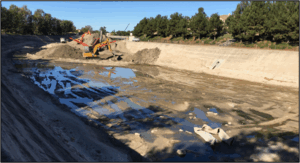
The three-year study, launched in July, will examine whether physical habitat restoration strategies like adding native vegetation, creating naturalistic side channels, and re-creating natural channel forms can be expected to improve the biological health of engineered channels. Engineered channels, which are ubiquitous across Southern California’s urban areas, are characterized by hardening of their banks and bottom, and/or modifications to channel shape.
During previous investigations, SCCWRP and the SMC evaluated two other potential options for improving the biological health of these streams: improving water chemistry, and restoring flow patterns to a less altered state. Researchers found that both options have the potential to result in some improvement in biological health for some streams, but likely not enough to meet potential regulatory targets for biological health. The findings have underscored the need to evaluate multiple strategies for improving stream health.
Streams that flow through engineered channels are much more likely to receive lower biological condition scores than their unmodified counterparts, as these modifications can eliminate habitat for aquatic organisms, disrupt natural hydrologic and sediment regimes, increase thermal stress, and increase susceptibility to eutrophication.
At the same time, options for improving stream biological health are often limited. For example, the primary reason for channel modifications is to help protect against flooding – a function that must be maintained.
California is increasingly adopting biology-based approaches for assessing and protecting stream health.
Regulations based on bioassessment index scoring tools already are in place across California, including in TMDLs (total maximum daily loads) and basin plans. Additionally, in 2020, the San Diego Regional Water Quality Control Board adopted a narrative biological objective for streams that uses the California Stream Condition Index (CSCI) – a tool co-developed by SCCWRP – as a numeric translator. This water quality standard, which is undergoing review by the State Water Resources Control Board and has not yet taken effect, applies to all natural channels, as well as engineered channels with soft or natural stream beds; it does not apply to streams that are “fully hardened” as a result of being lined with concrete, rock and similar materials.
As part of the newly launched engineered channels investigation, researchers will conduct a series of analyses of historical data. They will revisit the two previously studied management options in more depth – improvements to water chemistry and reductions to flow alterations – and simultaneously evaluate how physical habitat restoration projects can influence stream biological health.
The study aligns with the SMC’s research priorities outlined in its latest bioassessment workplan, which calls for investigating all three of these management options:
- Improve water quality by reducing the chemical stressors that can degrade biological health
- Restore flow patterns to a less altered state – an action that reflects the fact that engineered channels tend to experience significant flow modifications that can degrade biological health
- Pursue physical habitat restoration strategies – specifically, habitat changes that can be made without compromising a channel’s flood control functions
Managers may need to consider combinations of all three options to optimize their chances of improving biological health across Southern California’s diverse urban streams.
From these analyses, researchers hope to develop a management framework for identifying urban streams that are most vs. least likely to benefit from one or more of the three stream management options, enabling managers to prioritize streams and actions that show the most promise.
For more information, contact Dr. Raphael Mazor.
More news related to: Bioassessment, Ecohydrology, Southern California Stormwater Monitoring Coalition, Top News