Statewide framework successfully applied to first site-specific assessment of estuary health
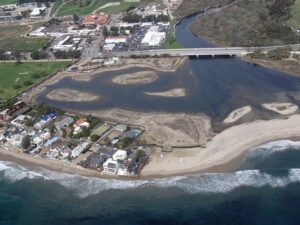
SCCWRP and its partners have used a newly developed statewide framework to evaluate the health of a Southern California coastal estuary – the first site-specific application of the framework for generating actionable insights about both ecological condition and causes of degradation.
The Santa Monica Bay estuary assessment – published in January as a chapter in the annual “State of the Bay” technical report – serves as an initial proof-of-concept for how to apply the California Estuary Monitoring Program’s standardized assessment framework to conduct site-specific evaluations based on ecological functioning. Historically, estuary health has been assessed using more simplistic, readily observable measures like the California Rapid Assessment Method (CRAM); while easier to conduct, these assessments are less directly tied to the beneficial-use goals that estuary managers are working to protect.
Already, the assessment approach laid out in the Santa Monica Bay pilot is being used to evaluate other estuary sites across the region through the Southern California Bight 2023 Regional Monitoring Program’s regional assessment of estuary health. The Bight ’23 final assessment report, which is expected to be published this summer, will enable the Santa Monica Bay assessment findings to be placed into a regional context.
The Santa Monica Bay estuary assessment targeted five sub-estuary sites within the larger Santa Monica Bay estuary, and marks the first time that small creek mouth estuaries were assessed; small creek mouth estuaries like Big Sycamore Canyon and Topanga Lagoon have been traditionally excluded due to lack of available protocols and data.
After the ecological function-based assessment was conducted, an expert technical panel was tasked with reviewing the data and working toward consensus on how to interpret the data, including assigning condition scores.
Via the panel process, overall condition was scored as AVERAGE or STABLE/CONSISTENT for Big Sycamore, Arroyo Sequit and Topanga Lagoon, and GOOD or IMPROVING for Zuma and Malibu Lagoons. The panel attributed the higher scores at Zuma and Malibu to the effectiveness of restoration and management actions.
The panel also reached consensus on the major stressors adversely affecting estuary health: altered watershed hydrology, mouth confinement, and excessive human visitation, plus the downstream effects of recent wildfires in some areas. Overall, the panel concluded that stress on Santa Monica Bay was AVERAGE and INCREASING.
After completing their evaluations, panelists agreed that the ecological function-based assessment generated monitoring insights that enhanced their ability to reach consensus, and that supported the defensibility in their conclusions.
The California Estuary Monitoring Program (CalEMP) is the name of the new statewide umbrella program that was created in February to bring enhanced structure and organization to both the Southern California Wetlands Recovery Project (WRP) Estuary Monitoring Program and the California Estuarine Marine Protected Areas (EMPA) Monitoring Program.
Both programs use the same assessment framework, and both programs are now housed within CalEMP’s newly created, integrated data portal.
The assessment framework was originally developed to support the EMPA program. Meanwhile, the WRP, which is made up of 18 local, State and federal management agencies, formally committed in December 2025 to begin incorporating the assessment framework into regulatory and grant requirements, as well as to coordinate monitoring efforts regionally.
The statewide estuary monitoring framework is modular in its design, giving participants flexibility to decide which aspects of wetland health they will monitor and how intensely – while simultaneously enabling disparate data sets to be stitched together to paint an overall picture of wetland health. For example, the Santa Monica Bay assessment was about twice as intensive as the Bight ’23 assessment that will be completed later this year.
Researchers’ goal is for the standardized framework to help managers evaluate the relative success of different wetland restoration projects.
California has spent more than $600 million over the past two decades to protect and preserve wetlands, but these efforts have largely been site-specific and siloed, with managers historically lacking rigorous assessment tools and a unified monitoring program to evaluate the causes of major stress on estuaries and the effectiveness of management interventions.
Coastal estuaries play a critical role at the land-sea interface, helping to buffer against coastal flooding, filter and retain contaminants, and provide critical habitat for vulnerable plant and animal communities.
For more information, contact Dr. Jan Walker.
More news related to: Climate Change, Climate Resiliency, Regional Monitoring, Sea Level Rise, Top News