Automated eDNA sampler deployed to enhance real-time HABs monitoring
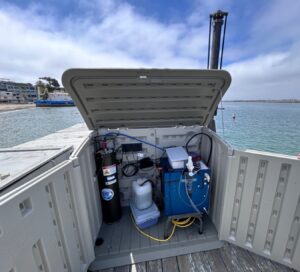
SCCWRP and the Kerckhoff Marine Laboratory in Orange County have begun exploring how to use an autonomous device that collects environmental DNA (eDNA) samples to enable real-time monitoring of early signs of harmful algal blooms (HABs) in Southern California coastal waters – an early effort to incorporate molecular technology into routine coastal monitoring.
The pilot project, which kicked off last summer, involves deploying an automated eDNA prototype sampling device off Newport Beach Pier to continuously collect water samples for eDNA processing and analysis in a laboratory. The sampling device was developed by the U.S. Geological Survey and Monterey Bay Aquarium Research Institute (MBARI).
The eDNA sampling device is deployed adjacent to an Imaging FlowCytobot (ICFB) managed by the Orange County Sanitation District, enabling researchers to collect paired eDNA samples and hourly ICFB images of phytoplankton; the goal is to understand if ICFB imaging could be used to trigger targeted eDNA sampling during early signs of a bloom event.
eDNA, which is the DNA that organisms shed into their environment, offers a promising complement to traditional field collection and identification of aquatic organisms, including toxin-producing algal blooms.
More news related to: Bioassessment, DNA Barcoding, Eutrophication, Harmful Algal Blooms