Bight ’23 highlights positive influence of source control in reducing trash in waterways
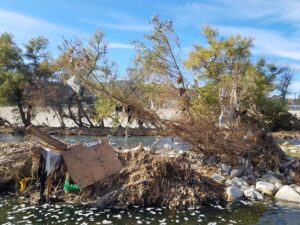
The Southern California Bight Regional Monitoring Program has completed its latest five-year assessment of how trash is spreading through the region’s aquatic environments – a study that provides compelling evidence that source-control actions over the past decade have been highly effective in reducing some trash in streams, even as questions remain about how trash on land is being transported to and settling onto the coastal ocean floor.
The Bight ’23 trash assessment, described in a technical report published in April, found that levels of single-use plastic bags observed in and along Southern California waterways decreased by 70% following a statewide plastic bag ban, while overall trash levels held roughly steady in these same areas.
In 2016, a statewide ban on carry-out plastic bags at grocery stores and pharmacies went into effect, following the law’s 2014 passage and a subsequent unsuccessful referendum to overturn it. Around the same time, California developed a regulatory program requiring areas with high trash-generating rates to install full-capture devices at storm drain inlets to block trash pieces larger than 5 millimeters in size (or develop an equivalent trash management strategy); the program, known as California’s Trash Amendments, was unveiled in 2015 and is being implemented in phases through 2030.
Numerous local and regional trash source-control actions also have been implemented over this time span.
Separately, the Bight ’23 trash assessment quantified the portion of Southern California’s coastal seafloor where trash can be found, continuing a monitoring practice that has been in place since 1994.
An estimated 19% of the coastal seafloor down to about 400 feet deep contains at least one piece of trash, according to the Bight ’23 seafloor assessment. By comparison, Bight ’23 found that an estimated 83% of Southern California’s 4,600 miles of streams draining to the coastal ocean contain at least one piece of trash.
What researchers cannot explain with the two data sets is how much trash in streams ends up in the ocean, or the transport mechanisms by which this movement could be occurring, including whether ocean currents and other conditions could be displacing trash further after it initially reaches the coastal seafloor.
It also remains unclear how much trash from land remains suspended in the water column, gets funneled into deep underwater canyons, and/or becomes trapped by other structures; all are areas where the Bight program does not do trash monitoring.
By contrast, the Bight program’s stream data sets have been successful at linking management actions to outcomes. In addition to the plastic-bag ban success story, researchers are hoping to use the regional stream data to track the effectiveness of the latest generation of source-control actions, including California Senate Bill 54, which was passed in 2022 and will require all single-use plastic packaging and food service ware to be recyclable or compostable by 2032.
Stream trash data are collected for the Bight program through a partnership with the Southern California Stormwater Monitoring Coalition (SMC).
Even with the publication of the Bight ’23 Trash assessment report, participants of this study element have not wrapped up their work. The Bight ’23 Trash element also is conducting a first-of-its-kind regional assessment of microplastics contamination, leveraging newly standardized methods for collecting and measuring microplastics particles in seafloor sediment and shellfish. These findings are expected to be published as a separate assessment report later this year.
For more information, contact Dr. Leah Thornton Hampton.
More news related to: Regional Monitoring, Southern California Bight Regional Monitoring Program, Top News, Trash Pollution