Regional monitoring network being leveraged to extend value of stormwater BMPs
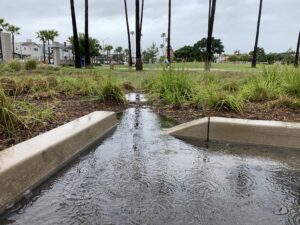
Participants of a SCCWRP-facilitated regional stormwater BMP monitoring network have developed recommendations for how to leverage the Southern California Stormwater Monitoring Coalition’s initial field monitoring data to jumpstart development of a focused BMP research agenda aimed at extracting more value from the hundreds of millions of dollars that public agencies spend on these structural stormwater control measures.
During a day-long workshop in March that attracted more than 100 attendees, the 18-member SMC agreed that its Regional BMP Monitoring Network has generated foundational insights that can both help improve existing BMPs (best management practices) that aren’t performing to their full potential, as well as help improve design and construction guidance for future BMPs being planned.
Based on these recommendations, researchers already have begun drafting scopes of work for additional potential SMC projects that would leverage the monitoring network to answer focused, high-priority management questions related to BMP performance.
Candidate SMC studies include working to isolate causes or characteristics of individual biofilter BMPs with exceptionally strong and poor performance, with a goal to refine design guidance for future biofilters. Other follow-up studies may include working to identify effective retrofit options and/or alternative designs to improve treatment performance for bacteria, nitrogen and other priority pollutants.
The SMC established the Regional BMP Monitoring Network in 2020 to generate high-quality, comparable data sets on the performance of bioretention systems, infiltration galleries and other types of structural BMPs across Southern California. BMPs can perform very differently in Southern California than in other, wetter parts of the U.S., underscoring the need to collect locally relevant performance data.
Although Southern California has implemented hundreds of structural BMPs over the past three decades, the region lacks robust data sets to comprehensively explain the factors and conditions that disproportionately influence how these systems perform – or underperform – and how this performance evolves over time.
While SMC member agencies will continue to do some monitoring of BMPs already in the network, the network wasn’t designed solely to generate extensive longitudinal data sets each year for tracking performance over time. Rather, researchers envision the network serving as a platform for adaptive monitoring – a regional platform upon which to build special studies that probe specific, focused management questions.
Over time, participants will be able to leverage the network’s existing monitoring infrastructure – which presently includes BMP sites from Los Angeles to San Diego – to study specific types of BMPs, specific classes of pollutants, and specific operating conditions and maintenance regimes. The network’s infrastructure includes everything from standardized field monitoring plans to data submission portals to custom-built data analysis tools.
During the March SMC workshop, SCCWRP provided a deep-dive overview of the BMP monitoring data collected to date. Altogether, data from 13 individual biofilter BMPs and more than 100 storm events have been collated via the network. Because of the limited number of storms in Southern California and the extensive planning and training required to collect BMP performance data, it took multiple years for the SMC to build this robust, regionally representative data set.
Already, the network’s data have helped the SMC to pinpoint weaknesses in performance metrics commonly used to assess BMP performance. For example, the Los Angeles County Flood Control District partnered with SCCWRP to build a scoring tool known as the Multi-Metric BMP Performance Index that quantifies the extent to which structural BMPs contribute to meeting downstream water quality objectives. Unveiled in 2025, the Multi-Metric BMP Performance Index represents an improvement over traditional BMP performance assessments that tend to focus on whether BMPs are meeting static expectations specified in BMP design manuals and water-quality regulatory targets. Early data sets from the SMC’s monitoring network helped bring into focus the need for such a tool and how it should be applied and interpreted.
For more information, contact Dr. Elizabeth Fassman-Beck.
More news related to: Regional Monitoring, Runoff Water Quality, Southern California Stormwater Monitoring Coalition, Stormwater BMPs, Top News