Training for accreditation assessors facilitates adoption of pesticide screening method
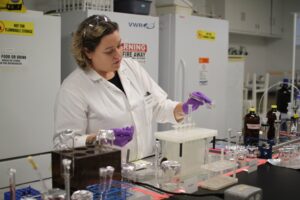
SCCWRP has trained a group of assessors who accredit environmental laboratories in California to evaluate laboratory proficiency in a new statewide method for monitoring up to 140 pesticides simultaneously – the final step in a three-year, SCCWRP-led effort to facilitate adoption and routine use of the screening method statewide.
During a three-day workshop held in October at SCCWRP, 20 accreditors from California’s Environmental Laboratory Accreditation Program (ELAP), along with third-party assessors, received hands-on training on how to use the method to screen and analyze field-collected samples for pesticides. The training paves the way for ELAP to begin accrediting environmental laboratories across California to use the new method in the coming months.
The multi-pesticide screening method reduces the need for managers to rely on a diverse range of siloed processing and analysis methods to monitor pesticides. These legacy methods require multiple samples to be taken, each needing to be processed in different ways by different methods, with samples incompatible across analysis instrumentation. Moreover, the pesticide-specific measurement approach may not identify all pesticides that may be present in the sample.
By enabling up to 140 commonly used pesticides to be detected using a single laboratory processing step, the new pesticide screening method makes it practical and cost-effective for environmental managers across California to increase routine monitoring of a broad range of pesticides.
The screening method was originally developed by the U.S. Geological Survey (USGS) and refined in 2020 in coordination with the Central Valley Regional Water Quality Control Board and USGS. A wide range of pesticides is being continually and increasingly used across the 38 million acres that make up the Central Valley region – not just to agricultural lands, but also managed forest lands – underscoring the need for improved pesticide screening methods.
Although the U.S. Environmental Protection Agency already has developed methods and guidance for measuring individual legacy pesticides like DDT – as well as other types of contaminants like polycyclic aromatic hydrocarbons (PAHs) and polychlorinated biphenyls (PCBs) – there is comparatively little federal guidance on how to efficiently and simultaneously monitor multiple current-use pesticides.
The new pesticide screening method uses a single lab processing step to produce a sample compatible with two common instrumental analysis techniques: gas chromatography/mass spectrometry (GC/MS) and liquid chromatography/tandem mass spectrometry (LC/MS/MS). It is designed for use with grab water samples, pump samplers and passive sampling devices that sorb contaminants like pesticides in water bodies.
To help pave the way for statewide accreditation of the new method, SCCWRP developed standard operating procedures (SOPs) and coordinated a multi-laboratory study to validate the method’s effectiveness.
The SCCWRP-led assessor training workshop in October was the final step that must be completed for ELAP to begin formally assessing laboratory proficiency using the new method.
Already, researchers are adapting the method to screen for pesticides and non-pesticide contaminants in other settings, including to support an ongoing, SCCWRP-led study measuring the efficiency of routine street sweeping in removing contaminants that would otherwise enter storm drains. For this study, the screening method is being used to analyze tire wear contaminants from the street sweeping samples.
Researchers have also begun exploring how to expand the method to monitor pesticides in urban and industrial environments, including post-fire monitoring efforts.
For more information, contact Dr. Charles Wong.
More news related to: Emerging Contaminants, Top News