Initial field sampling completed for study quantifying street sweeping’s efficiency
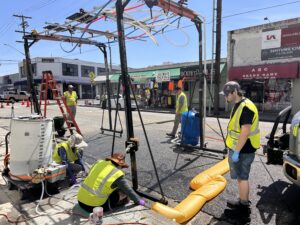
SCCWRP and the Southern California Stormwater Monitoring Coalition (SMC) have completed an initial round of field sampling for an ongoing study that will measure the efficiency of routine street sweeping in removing pollutants that would otherwise enter storm drains and contribute to runoff pollution.
During the sampling, researchers used a custom-built rainfall generator developed by SCCWRP to simulate rainfall on a set of swept roadway segments and a corresponding set of unswept segments. Researchers are now looking for differences in runoff pollutant levels that were generated by the two sets of roadway segments.
Already, researchers are planning a second round of more intensive field sampling in Los Angeles County that researchers hope will enhance the statistical confidence of the initial 10-site analysis.
Street sweeping is a type of non-structural BMP (best management practice) that is a routine part of stormwater management programs in communities across Southern California, but what has historically been unclear is what portion of stormwater pollutants – sediment, nutrients, trace organics and heavy metals, microplastics and bacteria – are removed from roadways via street sweeping.
More news related to: Emerging Contaminants, Runoff Water Quality, Southern California Stormwater Monitoring Coalition, Stormwater BMPs