Bight ’23 assesses estuary, eelgrass health using function-based approach
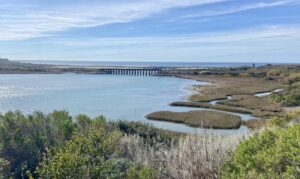
The Southern California Bight 2023 Regional Monitoring Program (Bight ’23) has completed the first assessment of the ecological health of Southern California’s estuaries and eelgrass beds – a regional-scale demonstration for how to evaluate both ecological functioning and causes of degradation for these fragile coastal habitats.
The two-part Bight ’23 assessment – published in August as the final reports of the Estuary Wetland Assessment and Submerged Aquatic Vegetation (SAV) study elements – marks the first time either habitat type has been included as a standalone study element in the regional monitoring program. Estuaries and eelgrass beds are among the most degraded habitats across Southern California’s coastal environments, even as monitoring efforts to track their condition have historically been underdeveloped.
The SCCWRP-facilitated Bight ’23 estuary and eelgrass assessments mark the latest in a series of successful demonstrations of the standardized assessment framework originally developed and piloted through the California Estuary Monitoring Program (CalEMP); the framework assesses the health of these environments based on their ecological functioning.
Historically, estuary health has been assessed using more simplistic, readily observable measures of condition. While easier to conduct, traditional assessments are less directly tied to the beneficial-use goals that estuary managers are working to protect. By contrast, the function-based approach evaluates how well an estuary or eelgrass bed performs ecological functions, such as supporting marsh plant communities, providing bird habitat, and keeping pace with sea level rise.
Prior to the regional-scale Bight ’23 assessments, the framework was piloted across 16 estuaries statewide through CalEMP, as well as applied at a site-specific scale to five sites across the Santa Monica Bay estuary.
The framework has now been found to work at the statewide, regional and sub-regional scales – a key milestone as researchers work to sustain a coordinated, statewide estuarine monitoring network intended to answer management questions.
Because the Bight ’23 assessment approach can accommodate multiple types of estuaries and data sources, Bight ’23 was able to leverage data from multiple ongoing monitoring programs to assess 19 estuaries across the region.
Overall, the region’s estuaries were found to be in moderate to good condition. Bight ’23 identified sea-level rise resilience as a systemic, region-wide vulnerability, with no site scoring in the High Function category – largely because estuaries lack room to migrate upland. Meanwhile, marsh plant communities were found to be generally in good condition across Southern California estuaries.
The function-based assessment also illustrated that overall site condition is not driven by a single factor or function. Even with assessing three functions during this survey, researchers found that the evaluation provided only a partial view of overall estuary condition.
The SAV study element, which evaluated eelgrass condition at 59 sites using a newly developed condition index scoring tool, found that more than half of the region’s eelgrass were in good or best observed condition. The assessment also found that acreage alone does not equal healthy function – an important insight for managers implementing the California Eelgrass Mitigation Policy, which mandates no net loss of eelgrass function.
The Bight ’23 findings are expected to help guide the newly approved Southern California Wetlands Recovery Project (WRP) Regional Monitoring Program, which uses a 37-site sentinel site network to track wetland health over time.
Researchers are exploring how to leverage the baseline Bight ’23 assessment data to track regional estuarine condition over time, likely by tapping into the recently developed statewide network of estuary monitoring programs nested under CalEMP, including the WRP Regional Monitoring Program and the statewide Estuary MPA (Marine Protected Areas) Monitoring Program.
Especially important will be tracking the effectiveness of management actions to protect and preserve wetland areas. California has spent more than $600 million over the past two decades on coastal wetland restoration and protection, but these efforts have largely been site-specific and siloed, with managers historically lacking rigorous assessment tools and a unified monitoring program through which to assess the effectiveness of management interventions.
For more information, contact Dr. Jan Walker.
More news related to: Climate Change, Climate Resiliency, Regional Monitoring, Sea Level Rise, Southern California Bight Regional Monitoring Program, Top News