Capacity being built in Monterey Bay to link monitoring of estuaries to dunes
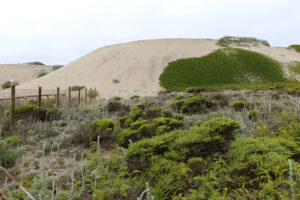
SCCWRP has begun working with monitoring partners in Monterey Bay to build capacity to track the health of coastal estuaries and dunes in a coordinated, linked fashion – a pilot project that researchers hope can serve as a proof-of-concept for how to integrate dune monitoring and estuary monitoring programs statewide.
The National Oceanic and Atmospheric Administration’s Climate Resilient Monterey Bay (CRMB) Regional Monitoring Program, for which SCCWRP is providing advisory support over the next three years, is the first effort within California to co-monitor dunes and estuarine wetlands using rigorous, standardized methods that focus on assessing the functional linkages between them.
Coastal dunes and estuaries are highly coupled systems; dunes help physically protect estuaries from ocean waves and storm surges, while estuaries provide critical habitat for birds and marine life that forage in dunes.
Although dune monitoring in California remains in the early stages of development, dune restoration already is increasingly being incorporated into coastal resiliency management strategies statewide, underscoring the need to develop standardized methods for measuring the ecological connections between the two habitats.
Researchers envision the Monterey Bay monitoring pilot serving as a statewide template for how to couple dune monitoring with the California Estuary Monitoring Program (CalEMP), the statewide umbrella program established earlier this year that encompasses both the Southern California Wetlands Recovery Project (WRP) Estuary Monitoring Program and the California Estuarine Marine Protected Areas (EMPA) Monitoring Program.
More news related to: Climate Change, Climate Resiliency, Regional Monitoring, Sea Level Rise