Statewide flows framework applied to support groundwater recharge decision-making
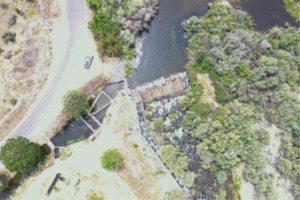
SCCWRP and its partners have demonstrated how a statewide scientific framework designed to help managers determine the environmental flow needs of California streams can also help shape groundwater management practices statewide – a key step toward helping California meet its water-supply targets without degrading stream health.
The case study, described in a SCCWRP technical report published in October, shows how to use the California Environmental Flows Framework (CEFF) to determine how much of a stream’s wet-weather flows can be diverted to support groundwater recharge, while still protecting the ecological benefits provided by the flows.
Under the statewide Flood-Managed Aquifer Recharge (Flood-MAR) strategy, California limits wet-season diversions supporting groundwater recharge to ensure the diversions do not risk compromising the ecologically important benefits that stream flows provide, including connecting channels to floodplains and supporting native aquatic life.
The case study helps build a scientific foundation for managers to pursue increasing these wet-season diversions to support groundwater recharge, while simultaneously accounting for the ecological importance of these flows as well as site-specific priorities and conditions.
The approach piloted during the SCCWRP-led case study is expected to help California achieve a statewide mandate to expand California’s water supplies by 9 million acre-feet by 2040. The California Department of Water Resources, which is charged with implementing this 2026 mandate from Governor Gavin Newsom, is identifying a toolbox of approaches to help streamline flow-diversion decisions, with CEFF viewed as one potential pathway.
In parallel, SCCWRP and its partners also are exploring how to use CEFF to better understand how groundwater pumping practices can affect surface stream flows and surface water temperatures during dry weather. When groundwater is pumped in an unsustainable manner, the practice can trigger alterations to both flows and temperature across connected surface-level streams. Thus, this separate, ongoing study represents the dry-weather corollary to the wet-weather diversion study – illustrating how to use CEFF to evaluate ecological effects across hydrologic conditions.
CEFF, which was co-developed by SCCWRP and unveiled in 2021, provides a rigorous, standardized approach for determining how to allocate limited surface flows to balance both human and ecosystem needs for flowing water. In recent years, management interest in CEFF as a climate adaptation planning tool has been growing. CEFF and the tools developed through the wet-weather diversion case study, for example, can help managers plan for the high-volume flows expected from Southern California’s upcoming El Niño wet-weather conditions, including identifying ways to make the most of periods of excess water to provide flood control, recharge groundwater, and protect ecosystem benefits.
During the case study, which kicked off in March, researchers applied CEFF to three streams across Northern California to determine how much of the stream’s wet-weather flows can be diverted to support groundwater recharge, while still protecting the ecological benefits provided by the flows.
Researchers also compared CEFF to other diversion approaches, including a cumulative wet-weather approach (“80/50 rule”) and the State Water Board’s permitting approach for Flood-MAR projects (“90/20 rule”).
Researchers found that each approach involved different tradeoffs. The 90/20 rule offered streamlined permitting, but made less water available for groundwater recharge – and during short, scattered windows. The 80/50 rule allowed longer, more continuous diversions that were simpler to manage, but resulted in greater alteration of ecologically important high-flow events in the streams evaluated.
By contrast, CEFF-based criteria allowed for diversion volumes comparable to the 80/50 rule while better preserving ecologically significant high-flow events in the streams evaluated.
Key to CEFF’s management utility is that it does not prescribe a single approach for how to balance flow diversions with a stream’s environmental flow needs. Rather, CEFF enables managers to adopt a toolbox approach to evaluate diversion strategies based on site- and project-specific considerations and management priorities.
Building on the study’s findings, SCCWRP and DWR have begun initial conversations with local landowners and groundwater agencies, including in Napa County, about using CEFF to identify wet-weather flow volumes that could be diverted to support groundwater recharge. Researchers’ goal is to incorporate these CEFF diversion analyses into water-rights applications seeking approval for increased flow diversions – a critical next step toward CEFF being able to guide real-world groundwater management decisions.
For more information, contact Dr. Kris Taniguchi-Quan.
More news related to: Ecohydrology, Top News