Workshop helps shape stormwater management resources for U.S. Southwest
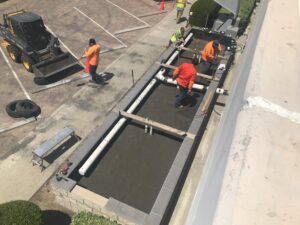
Stormwater managers, practitioners and stakeholders from across four Southwestern states provided feedback on how to expeditiously transfer regionally relevant, best-practices stormwater solutions and provide technical support to end users during an inaugural, two-day workshop for the regional Southwest Stormwater Center, established by the U.S. Environmental Protection Agency and co-led by SCCWRP.
The workshop, held June 9-10, 2026 at SCCWRP, brought together about 125 stormwater representatives from Southern California, Nevada, Arizona and New Mexico to identify and help shape technical tools, information and products that arid and semi-arid Southwestern states could use to more effectively respond to the region’s unique stormwater management challenges. The SWSC is one of four U.S. regional Centers of Excellence for Stormwater Control Infrastructure Technologies.
Many stormwater management solutions that have been developed for wetter regions of the United States are not directly applicable to the arid and semi-arid Southwest, where rainfall events tend to be infrequent but intense. These rainfall patterns can quickly overwhelm stormwater management and drainage systems, disrupting people and ecosystems and necessitating extensive operations and maintenance regimes.
During the workshop, end users acknowledged that there is already a broad suite of models, assessment tools, decision frameworks, and cost and asset management tools. Workshop attendees encouraged the Southwest Center to build off this body of work, developing “state of the practice” documents that provide high-level overview of topics, as well as fact sheets and case studies to help them tailor solutions to local contexts.
Workshop participants also highlighted the need for region-specific pollutant and asset data, best practices for incorporating stakeholder feedback into watershed plans, and information on practical lessons and maintenance concerns to inform the selection of stormwater BMPs (best management practices).
To enable stormwater capture and use projects – which remains an unfamiliar new frontier for many stormwater practitioners – workshop attendees emphasized the need for practical guidance on how to identify the physical infrastructure required to make capture and use a reality, based on a user’s unique needs and resource availability. The guidance should include case studies documenting a diversity of approaches successfully used in the real world, enabling practitioners to identify and adapt case studies to their local context.
Workshop attendees also suggested improved guidance on watershed planning, including watershed modeling. With a plethora of watershed management strategies and planning tools to choose from, practitioners need clarity on how tools align or differ, and a decision tree to help users select from them according to their needs and resource availability.
The Southwest Stormwater Center aims to bridge gaps between isolated but regionally relevant information sources by synthesizing, harmonizing, consolidating and sharing technical knowledge, tools, and resources across five priority topic areas: BMP design and assessment, stormwater planning, stormwater capture and use, funding and financing, and stakeholder engagement.
The Center is co-led by SCCWRP and the Desert Research Institute in Nevada, along with partners at the University of California, Los Angeles, University of Arizona, Bernalillo County in New Mexico, and the WaterNow Alliance.
The two-day workshop featured a public session introducing the Center and its goals, followed by a closed working session focused on identifying stakeholder priorities. Multiple SCCWRP and Southern California Stormwater Monitoring Coalition (SMC) member agencies attended the workshop in person and virtually.
Also surfaced during the workshop are important regional differences in stormwater priorities across the Southwest; for example, while Southern California’s stormwater community emphasized water-quality treatment as a key research need, Nevada representatives said their priority is identifying BMP implementation strategies for managing flashy flows and high sediment loads.
Not only did participants reach consensus during the workshop about the what type of information would provide the greatest value to practitioners and managers, but they also agreed on best practices for how to disseminate this information – whether via state-of-the-practice reports, fact sheets, web tools and/or videos.
The Center already has begun using the workshop recommendations to refine its planned products and resources. All final products, including guidance documents, journal manuscripts, trainings and webinars and other resources, will be made available on the Center’s website.
For more information, contact Dr. Elizabeth Fassman-Beck.
More news related to: Stormwater BMPs, Top News