Bight ’23 Ocean Acidification partnerships enhance West Coast biological monitoring
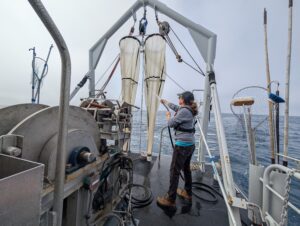
The Southern California Bight 2023 Regional Monitoring Program’s Ocean Acidification study element has begun working to assess the effects of ocean acidification (OA) on shell-forming organisms in close coordination with two other West Coast ocean monitoring programs – a collaboration intended to promote standardization of OA biological monitoring across the West Coast and ensure OA’s effects on Southern California marine organisms can be placed into a broader regional context.
The California Cooperative Oceanic Fisheries Investigations (CalCOFI) and NOAA West Coast Ocean Acidification (WCOA) program began OA biological sampling in Southern California coastal waters farther offshore in July, the same time period that Bight ’23 is conducting OA biological sampling in nearshore waters. The biological sampling is being complemented by ocean chemistry measures of OA.
A key priority for the SCCWRP-facilitated Bight ’23 OA study element will be identifying a shell-forming species that can serve as an indicator of OA’s biological effects in Southern California coastal waters. During the first coordinated sampling effort in 2021 and 2022, the species that all three West Coast OA monitoring programs tracked – a tiny sea snail known as Limacina helicina – could not be found in sufficient abundance in Southern California nearshore waters to generate a reliable assessment of OA’s biological effects.
As a result, researchers have not yet been able to compare how marine organisms in nearshore Southern California waters are being affected by OA relative to what is happening West Coast-wide. Researchers’ goal is to stitch together biological data from multiple West Coast monitoring programs to create a unified, comprehensive picture of OA status and trends.
The coordinated, summer-long OA field sampling event follows years of collaborative work by the trio of monitoring programs and other partners to develop repeatable, standardized methods for tracking OA-triggered shell dissolution in shelled marine gastropods.
This method development work culminated with a one-year intercalibration exercise facilitated by SCCWRP and CalCOFI, completed in June, that standardized the process by which gastropod shell dissolution is analyzed under a scanning electron microscope. This new protocol can now be used on the samples collected by all three programs during this summer’s field sampling.
Shelled gastropods are sensitive to OA’s corrosive effects, enabling them to serve as sentinel biological indicators of the pace and intensity with which OA is unfolding across the West Coast.
To address the Limacina data gap in Southern California, all three programs have agreed to sample alternate swimming marine snail species this summer that could potentially complement Limacina monitoring. Researchers are focusing initially on Clio pyramidata – a type of sea snail known as a pteropod – and Atlanta californiensis – a heteropod species. Both are commonly found in the warmer waters of Southern California; the other two monitoring programs are examining whether these species can be found in abundance farther north as well.
Researchers envision developing a suite of shell-forming organisms to serve as sentinel biological indicators for tracking West Coast OA. Data from different biological indicators across different parts of the West Coast would enable researchers to take a multiple-lines-of-evidence approach to tracking OA’s biological effects, with a goal to enhance management understanding and confidence in OA monitoring data.
Researchers hypothesize that Southern California coastal waters may be too warm for Limacina – or at least they were during the years Southern California OA biological sampling was previously conducted. CalCOFI, which samples further offshore, successfully sampled Limacina at some offshore sites in Southern California, while the Bight program identified Limacina during the wintertime in mostly cooler, upwelling-dominated waters in the Santa Barbara Channel.
If promising alternate indicators can be identified this summer, Bight ’23 may follow up with subsequent rounds of sampling to investigate seasonal patterns in shell dissolution.
In addition to monitoring ocean chemistry and shell dissolution, the trio of programs are piloting the use of environmental DNA (eDNA)-based methods for tracking OA’s biological effects on marine life.
Biology is one of two approaches that researchers are taking to track OA in coastal waters. The other approach – tracking ocean chemistry – already has been implemented by West Coast OA monitoring programs, including the Bight program.
This summer’s coordinated OA sampling effort highlights all three monitoring programs’ shared commitment to building a comprehensive picture of West Coast OA. While the Bight program monitors OA in Southern California nearshore coastal waters, the CalCOFI and WCOA surveys are focused on monitoring OA farther offshore and northward.
For more information, contact Dr. Christina Frieder and Dr. Martha Sutula.
More news related to: Climate Change, Ocean Acidification and Hypoxia, Regional Monitoring, Southern California Bight Regional Monitoring Program, Top News